"Do you have a pot I could cook this in?" · DECEMBER 2025
- Kristin McBenton
- Apr 25
- 4 min read

The question that started Rising Tide's crock-pot program — and the system it became.
I had just finished helping run our school's Thanksgiving basket program, partnering with a local organization to get holiday meals into the homes of families who needed them. I was already thinking about what came next — the Angel Tree, Christmas presents for our students — when something started bothering me.
Our kids were going to have gifts. Good. But they were also going to have two weeks at home with no school breakfast, no school lunch, and parents who, in many cases, were already stretching nothing into something. We were giving them things. Their parents were going to be giving them dinner out of an empty pantry.
So I started talking to a coworker about what we could do. And in one of those conversations, I brought up a question, that a student we were helping had asked us that I haven't been able to forget.
"This food is great. But could I please have a pot to cook it in?"
That sentence reframed the entire problem. We weren't just facing a food gap. We were facing a capability gap. Some of these families didn't have a working stove. Some were living in motels. Some had a kitchen but no equipment to use in it. Handing them groceries without a way to cook them was, in some cases, just handing them another problem.
A crock-pot solves that. All it needs is an outlet. It works in a hotel room, a borrowed apartment, a kitchen with a broken stove. You plug it in, you walk away, you come back to a meal. For a parent working two jobs, or a teenager cooking for their younger siblings, that's not a convenience. That's the difference between dinner and no dinner.
So that became the plan. Thirty families. Thirty crock-pots. A week of meals each.
How we actually did it
I want to be honest about the resources behind this, because I think it matters.
We did not have $5,000 sitting in an account. We had two educators — me and one coworker — and a network of friends. A nonprofit foundation that a former colleague had started donated the 30 crockpots. We funded the food the same way we still fund most of our work: by asking specific people for specific things.
I called every one of the 30 families personally. Not to tell them they were getting help — to ask them what they actually kept in their pantry. What they liked to cook. What their kids would actually eat. Because the fastest way to insult a family in crisis is to hand them food that ends up in the trash.
Then I sent friends and family a recipe book of slow-cooker meals and asked them each to "adopt" a recipe, and make it 5 to 10 times. They'd buy the pantry staples and include a gift card for the protein and dairy. Other people dropped off cans, flour, sugar, rice — whatever they could.
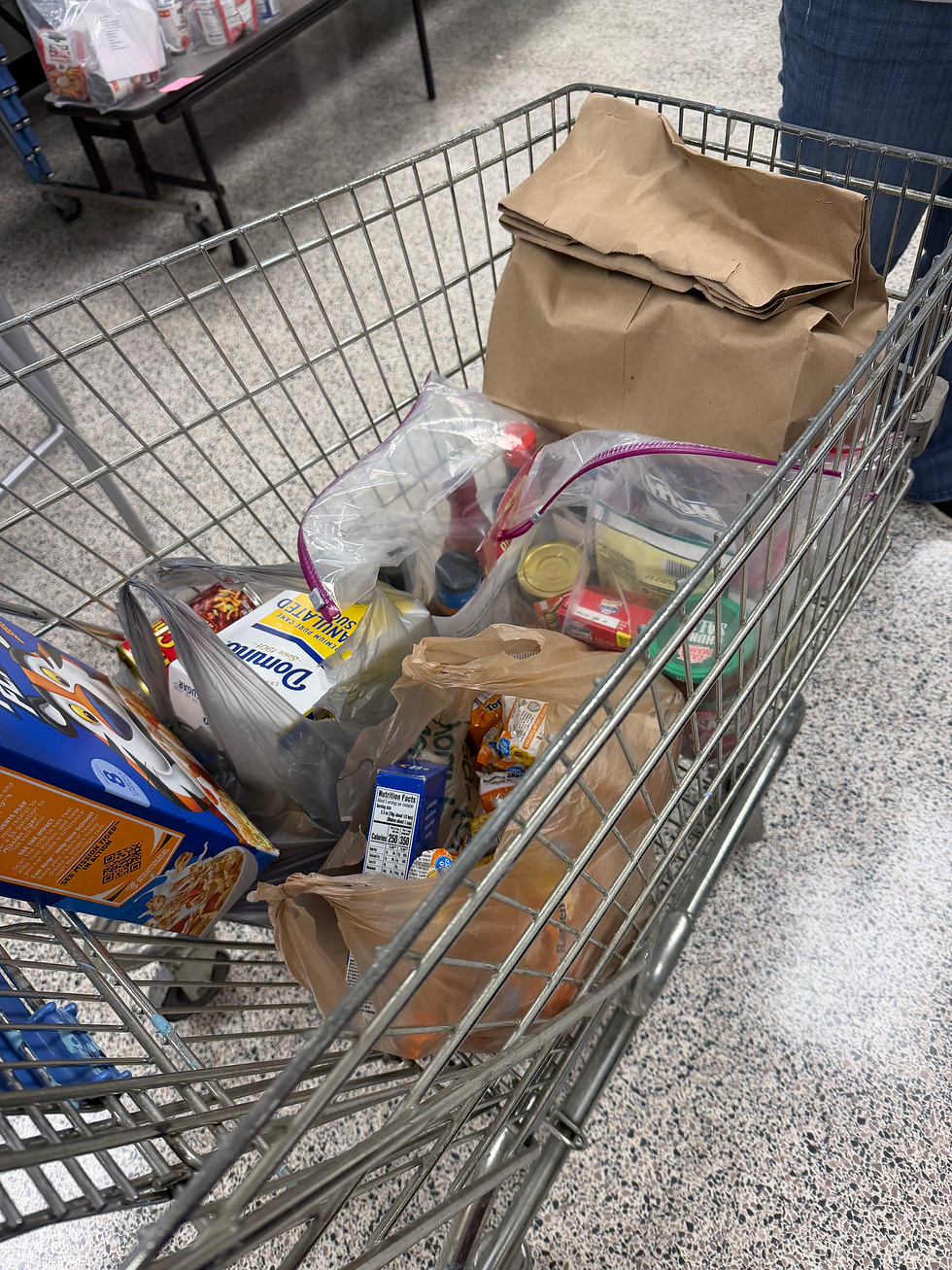
The day of the distribution, we set up a room on campus. Every crock-pot was wrapped. Each family arrived, took a shopping cart, and walked through stations of meals organized by type. They picked the meals they wanted. Then they walked through tables of pantry staples and took whatever else their family would actually use.
The thing I said most that day was, "If you'll eat it, take it. It's not here to look pretty."
Most families had to be told twice. They kept asking if they were sure. They kept apologizing for taking too much.
The moment that gutted me
One of our students thanked me — not for the food, but because the crock-pot meant they could now cook for their younger siblings while their mom worked. They had been trying to figure out how to feed their family every night. They didn't have the skills to plan a meal from scratch, and the ingredients weren't always there anyway. A crockpot recipe — dump it in, plug it in, walk away — was something they could actually do.
That's a kid carrying adult weight. And a $40 piece of equipment lifted some of it off them.
Why this isn't a Christmas story
The reason I'm telling you this in April (besides the fact that I'm just getting around to writing it up) is because the crockpot program didn't end in December. It became the way Rising Tide does food.
Our on-campus food pantry now stocks crock-pot meals year-round. Students come in weekly to take meals home for their families. Every time we identify a new family in need, a crock-pot is part of how we welcome them. The recipe book keeps growing. The pantry keeps restocking. The 30 families became a system.
That's the model. We don't run programs. We build infrastructure that keeps working after the holiday is over.
What you can do
$50/month makes you a Barrier Breaker. Recurring support is what lets us respond the day a student asks for help — not weeks later. Become a monthly donor.
— Kristin McBenton Founder, Rising Tide



Comments